Benchmark
Per-step wall time of the Lennard-Jones Langevin example for two systems — a bulk liquid in a periodic box and a droplet in vacuum (non-periodic) — across system sizes, for the full cross-product of device (CPU / GPU), neighbour list and kernels (Warp / array (NumPy/CuPy) / JAX / C++). Lower is better. The neighbour-list backends are:
- matscipy-neighbours — this library (
matscipy_neighbours), CPU + GPU; - matscipy 1.2.0 — the classic
matscipypackage'sneighbour_list, the CPU reference this library descends from; - vesin —
vesin, CPU + GPU; - ALCHEMI — NVIDIA ALCHEMI's
nvalchemiopscell list (method="cell_list"), GPU only, through its PyTorch interface (Warp and array kernels) and its JAX interface (JAX kernel).
What is being measured
Every step rebuilds the neighbour list from scratch, and the list is the dominant cost of a step here. That is deliberate: these runs are set up to expose the neighbour-list performance as much as possible. In a real application one would build the list with a Verlet shell (a skin added to the cutoff) and reuse it for many steps until an atom has moved half the skin, so the total time spent constructing neighbour lists plays a much smaller role in the overall cost of a simulation than it does below.
Test machine
- CPU: AMD EPYC 9654 96-Core Processor (23 usable cores)
- GPU: NVIDIA H200
CPU threading
On the CPU the matscipy-neighbours list is benchmarked both
single-threaded (OMP_NUM_THREADS=1, the (1t) curves) and
multi-threaded (all 23 usable cores, the (mt) curves). The
C++ force loop is OpenMP-parallel and follows the same setting; the Warp and
array kernels and the JAX backend use their own threading. The classic
matscipy 1.2.0 and vesin CPU lists are single-threaded. The GPU
curves are unaffected.
Pair list or neighbour matrix
A neighbour list comes in two layouts. The pair list is three flat
arrays i, j, S with one entry per pair; every backend returns it, and
the array, Warp and C++ kernels run one thread (or array element) per
pair. The neighbour matrix gives each atom a row of fixed capacity
(here 96 slots) plus a neighbour count; its shapes are static, so the JAX
kernel uses it, and it is ALCHEMI's native layout (its pair list is
compacted from the matrix). The Warp panels therefore show the GPU curves
of matscipy-neighbours and ALCHEMI twice: on the pair list, and on the
matrix ((matrix), one thread per atom summing its own row). In the matrix
form both libraries supply the same data — neighbour indices, plus the
cell shifts in the periodic box (neighbour_matrix(...,
quantities="S"), or "" for the droplet) — to the same kernel.
Missing curves
vesin and matscipy 1.2.0 only feed the Warp and array kernels, and ALCHEMI the Warp, array and JAX kernels: JAX needs a fixed-capacity neighbour matrix, and the C++ example uses the in-tree C++ core. matscipy 1.2.0 is CPU-only, and ALCHEMI is benchmarked on the GPU only. A curve that ends before the largest size either ran out of GPU memory at the next size (e.g. the JAX dense neighbour matrix, or the per-pair arrays of the array kernels) or was stopped because its next run was predicted to take longer than 60 s.
Run configuration: reduced LJ units, cutoff 2.5, dt 0.005, friction 1.0, temperature 0.7; sizes from 100 to 30,000,000 atoms. CPU runs stop at 1,000,000 atoms; the GPU runs cover the full range. Up to 40 steps per point (fewer for the largest systems; JAX and Warp are compiled once during an untimed warm-up; JAX runs without its default up-front reservation of GPU memory, which would leave too little for the neighbour list). Both systems start from an FCC lattice; the droplet uses lattice constant 1.6, the liquid fills its box at the stated density.
Periodic: bulk liquid
A homogeneous liquid at reduced number density 0.8442 in a fully periodic cubic box: every grid cell is occupied (dense grid), and pairs across the boundary carry a non-zero cell shift. At temperature 0.7 the default density is the Verlet (1967) state point (also the LAMMPS LJ benchmark's), a liquid at positive pressure well away from coexistence. This is the geometry a bulk molecular-dynamics or structure-analysis workload sees, and it removes the vacuum that favours cell lists in the droplet case, so it is the fairer comparison between the list implementations.
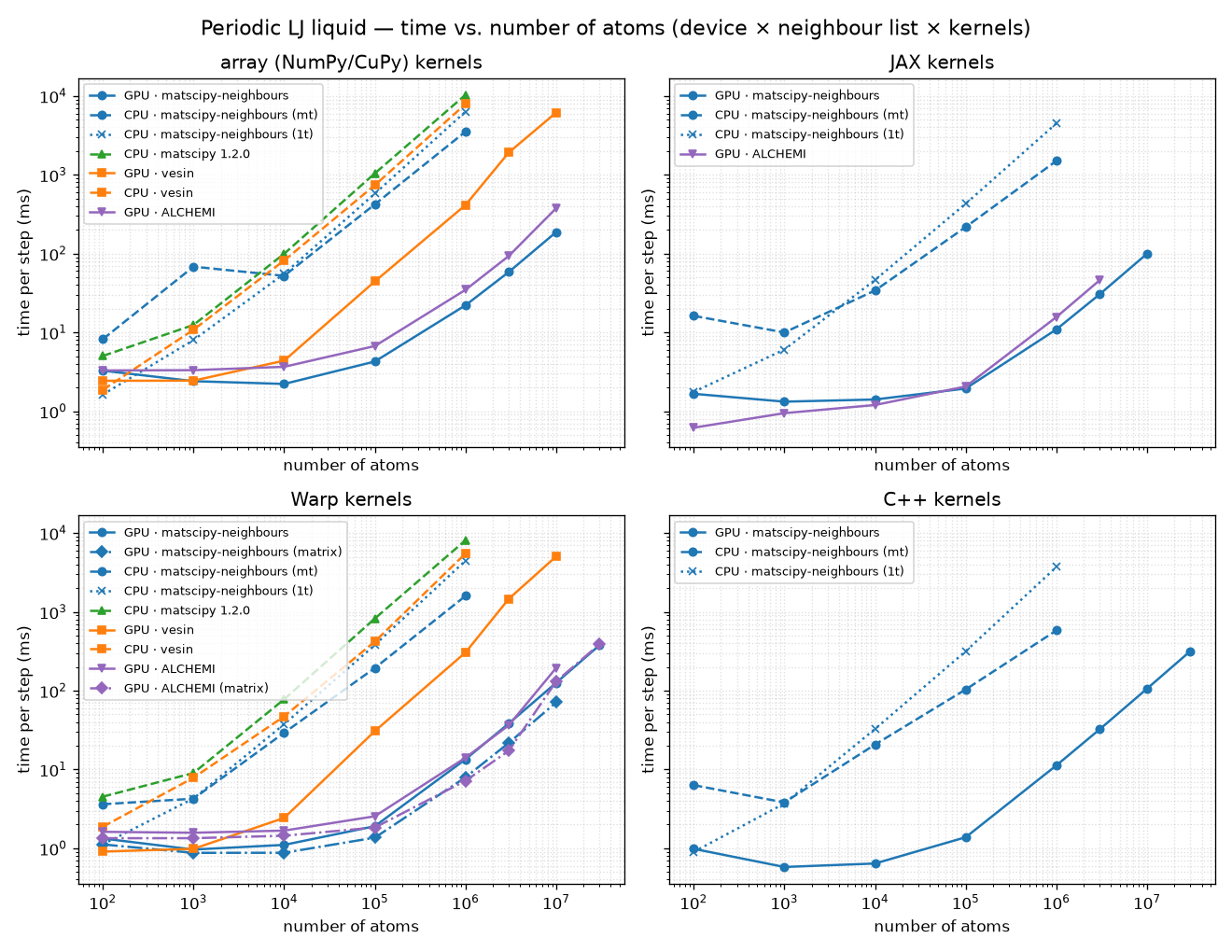
How to read it (on the test machine):
- On the GPU the list build dominates the step for the Warp and C++ kernels, which avoid per-pair arrays, and the array kernel adds a roughly constant factor on top. The list choice therefore drives the scaling. JAX, which consumes the neighbour matrix (the faster list to build), is on par with the fused kernels.
- In the matrix format (the Warp
(matrix)curves, where both libraries supply indices and cell shifts to the same kernel) ALCHEMI is ahead from 10⁶ to 3×10⁶ atoms (by 10–25%), matscipy-neighbours below 10⁶ atoms and at 10⁷ atoms (there by almost a factor of two). At 3×10⁷ atoms matscipy-neighbours' matrix runs out of GPU memory: its int64 indices and shifts take twice the space of ALCHEMI's int32 ones. - On the pair list matscipy-neighbours is ahead below 10⁶ atoms, the two are within about 5% from 10⁶ to 3×10⁶, matscipy-neighbours is ahead at 10⁷ atoms, and only matscipy-neighbours reaches 3×10⁷ atoms, where its pair list is also slightly faster than ALCHEMI's matrix.
- In the JAX panel matscipy-neighbours'
neighbour_matrixis faster than ALCHEMI's jit-compiled cell list from 10⁵ atoms on and reaches 10⁷ atoms, while ALCHEMI runs out of GPU memory above 3×10⁶. - vesin's GPU path is more than an order of magnitude slower than both at 10⁶ atoms and grows super-linearly.
- On the CPU, single-threaded matscipy-neighbours
(1t)is faster than both the classic matscipy 1.2.0 and the vesin CPU lists at every size measured. - Per atom the liquid has more neighbours within the cutoff than the droplet, whose surface atoms have fewer, so absolute times are somewhat higher.
- The periodic shifts are folded into the distance vectors by the list (array and JAX kernels) or applied from the shift array in the fused kernels (Warp and C++), so no kernel wraps positions itself; atoms are free to drift out of the box.
Non-periodic: droplet in vacuum
A self-bound liquid droplet in a non-periodic, generously padded box: most of the cell grid is empty, so this exercises the sparse (hashed) grid and a list without periodic images.
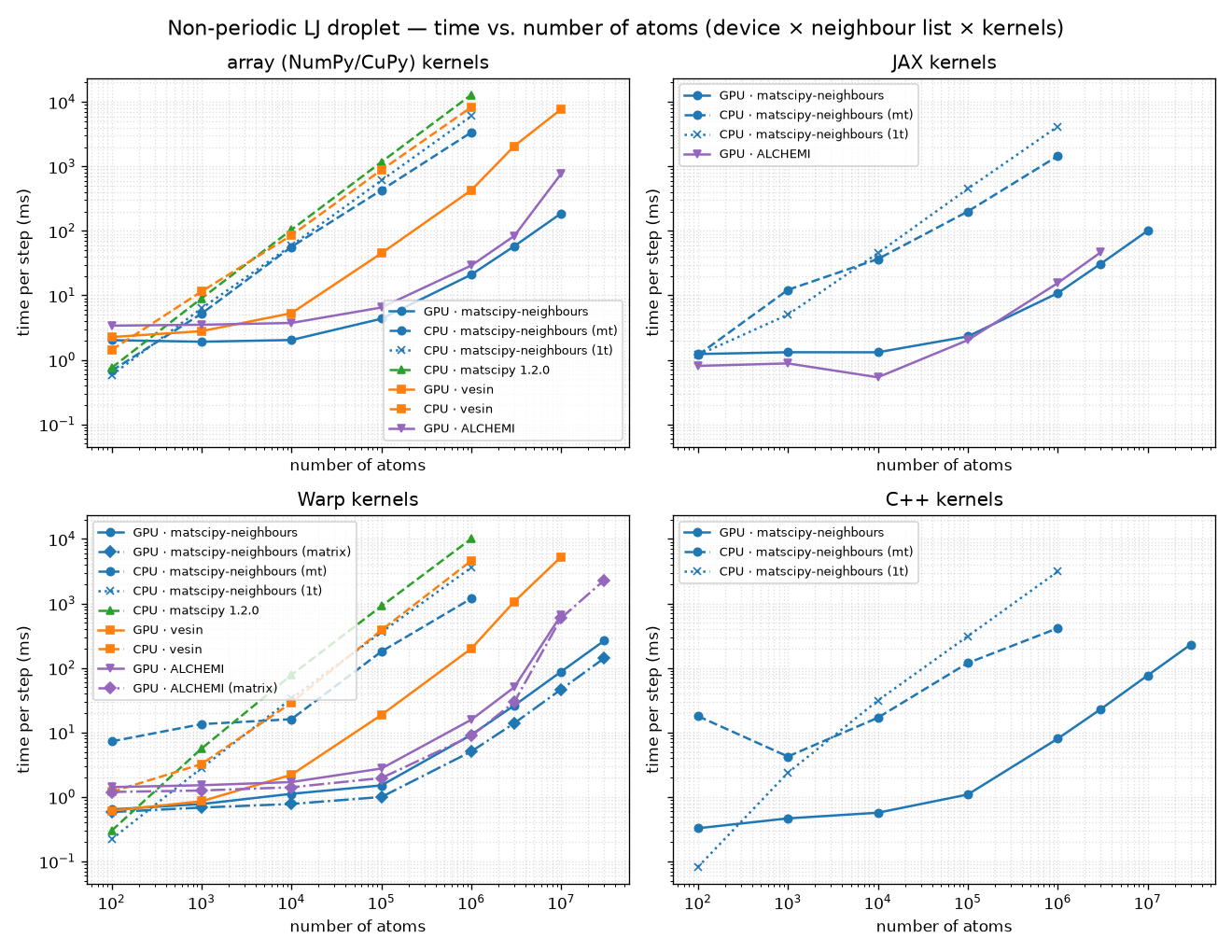
How to read it (on the test machine):
- matscipy-neighbours scales linearly on the GPU up to the largest size. Its neighbour matrix (indices only, as the non-periodic droplet needs no shifts) is the fastest GPU list at every size, and its pair list is faster than ALCHEMI's pair list at every size.
- ALCHEMI's list build grows super-linearly beyond a few million atoms on this sparse geometry: from 3×10⁶ to 10⁷ atoms its build time rises about twentyfold for 3.3× the atoms, and its curves end well above matscipy-neighbours'.
- vesin's GPU path grows super-linearly and falls far behind for these large, low-density droplets.
- On the CPU, single-threaded matscipy-neighbours
(1t)is faster than the classic matscipy 1.2.0 and vesin CPU lists from about 10⁵ atoms on; the multi-threaded(mt)curves pull away as the system grows (at small sizes the thread start-up cost dominates).
Kernel comparison: the cost of the Lennard-Jones implementation
The figure below keeps the neighbour list fixed — matscipy-neighbours on
the GPU, and on the CPU single-threaded — and varies only the kernels that
consume it: array (NumPy/CuPy), JAX, Warp and C++/CUDA. Within one device the
array, Warp and C++ curves share the same pair-list build, so the vertical
spread between them is the cost of the potential, not of the list; JAX
consumes neighbour_matrix instead, which on the GPU builds faster than the
pair list (see the matrix curves in the Warp panels), so part of JAX's lead
there is the list. This section therefore does
not primarily benchmark the neighbour list but the implementation of the
Lennard-Jones potential on top of it:
- the array path materialises the per-pair distance vectors returned by the
list and scatters the forces with a
bincountper component; - JAX
jit-compiles a dense masked sum over the fixed-capacityneighbour_matrix(no scatter, but padded rows); - Warp and C++/CUDA run one fused pass over the
ijpairs (plus the shiftSin the periodic box) that recomputes each distance and never materialises per-pair arrays; on the GPU the potential energy is reduced within each thread block and added with one atomic per block.
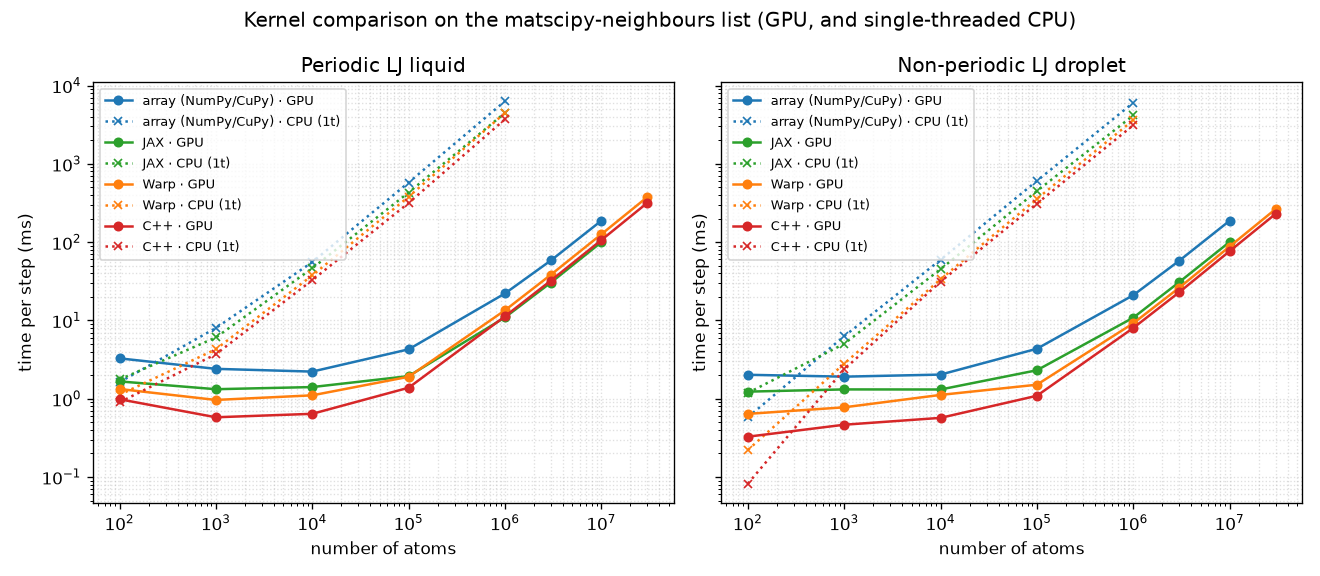
The C++ force loop is OpenMP-parallel and honours the single-thread setting; the NumPy, Warp-CPU and JAX-CPU kernels use their own threading and are not pinned to one core, so on the CPU the comparison is indicative rather than strict.
This page is generated by examples/lj_langevin/benchmark.py. Regenerate it on
your own hardware with:
The raw timings are written to --results-out (JSON); pass that file to
--replot to redraw the plots and this page without re-running the benchmark
(the kernel-comparison figure is drawn from the same results). --systems
liquid or --systems droplet restricts the run to one system. For
the C++ curves, build with -DBUILD_EXAMPLES=ON (and -DENABLE_CUDA=ON for
the GPU binary); the others need pip install jax warp-lang vesin muTimer
matscipy==1.2.0 matplotlib nvalchemi-toolkit-ops and a CUDA build of PyTorch
(for ALCHEMI) in the interpreter that runs this driver.